Build a Single Source of Truth With Data Cloud
Fragmented data across Salesforce, ERP, SIS, and data warehouses limits your ability to make confident decisions. We consolidate your data into Data Cloud, creating unified profiles that give you a complete view of students, donors, customers, or citizens all in one place.

Data Cloud implementation with harmonization and unification of 2-4+ external data sources into a single Customer 360 view.
Data architecture and modernization including Snowflake integration, data lakes, and real-time data pipelines.
Segmentation and cohort creation for targeted engagement, personalized experiences, and AI-powered workflows.
Forecast Outcomes With Predictive AI
Stop reacting after outcomes occur. We design predictive AI solutions using Salesforce Data Cloud and Einstein to forecast key outcomes—such as enrollment likelihood, donor retention, churn risk, or operational performance—so teams can take action earlier and with confidence
Predictive models built with Einstein on Data Cloud Up to three custom predictions aligned to your business goals (e.g., likelihood to enroll, likelihood to give, propensity to churn), trained on unified, trusted data.
Actionable analytics with Tableau and embedded Salesforce insights Dashboards and score-based views surfaced directly in Salesforce to support real-time decision-making—not standalone reports.
Activation workflows driven by predictive signals Segmentation and automation that trigger journeys, tasks, or agent actions based on predictive scores and behavioral signals.
Agentforce: Deploy AI Agents That Take Action
Agentforce goes beyond conversational AI. We design and implement autonomous agents that take action across Salesforce—handling inquiries, qualifying leads, processing applications, routing work, and executing workflows—while operating within defined guardrails and governance.
Autonomous agents designed around real business workflows Agents built for use cases such as admissions support, donor engagement, case routing, internal operations, and field assistance—integrated directly into Salesforce data and processes.
Incremental rollout from prototype to production We start with focused, working agents to validate value and adoption, then expand capabilities over time as confidence and complexity grow.
Governance, monitoring, and continuous improvement Agent performance management, human-in-the-loop controls, monitoring, and retraining strategies to ensure agents remain accurate, compliant, and aligned with business goals.
How Our Salesforce Data Services Work
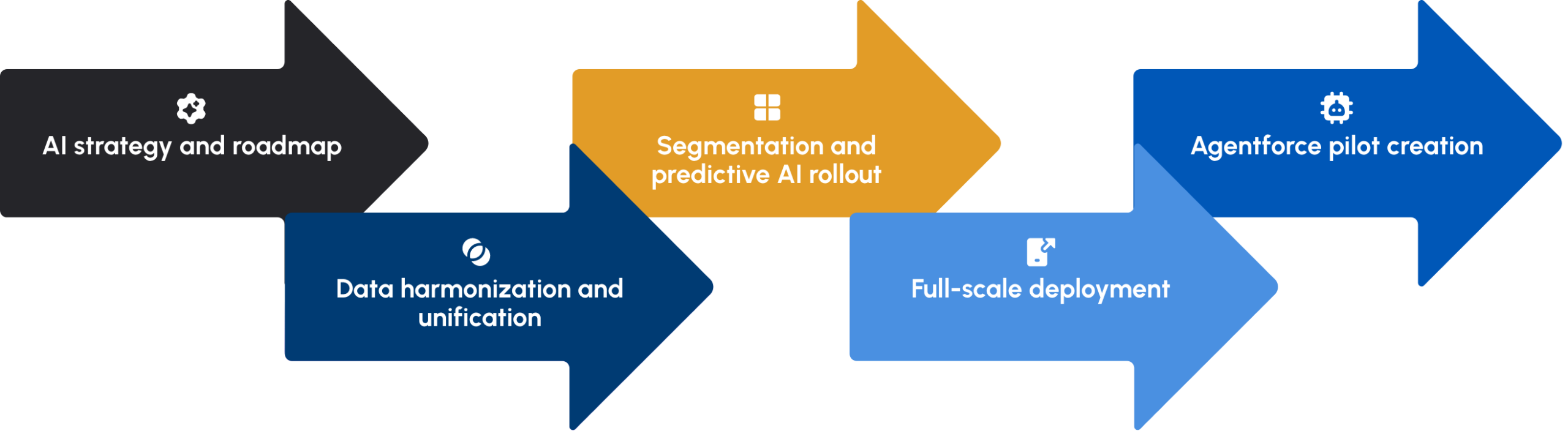
We follow a phased AI transformation approach, beginning with strategy and roadmap development to align business goals, data readiness, and AI opportunities.
Execution then progresses through data harmonization and unification to create a trusted, 360-degree business view, followed by segmentation and activation to enable targeted AI use cases and workflows. Predictive AI capabilities are layered in to surface forward-looking insights, and the journey culminates with Agentforce—deploying agentic and generative AI to automate and personalize actions at scale.
This approach delivers incremental business value at each stage while building a strong foundation for sustained, AI-powered transformation.

Featured Client Story: Big Picture Learning
Intent-Driven Internship Discovery with Agentic AI
We helped Big Picture Learning enhance its ImBlaze internship platform by introducing AI-powered semantic search and intelligent automation, making it easier for students to discover opportunities aligned with their interests. Instead of relying on exact keyword searches, students can now explore internships naturally while automated agents continuously discover and enrich new opportunities for schools.
Salesforce Data Services FAQs
What is Data Cloud and why do we need it?
Data Cloud is Salesforce’s platform for unifying fragmented data from multiple systems into a single Customer 360 view. It creates unified profiles by ingesting data from Salesforce, ERP, SIS, marketing platforms, and data warehouses then harmonizing it so you can segment audiences, run predictions, and activate AI workflows. It’s the foundation for predictive and agentic AI.
What’s the difference between predictive AI, generative AI, and agentic AI?
Predictive AI helps you anticipate what is likely to happen by forecasting outcomes such as enrollment likelihood, donor retention, or churn risk. Generative AI helps teams work faster by creating and summarizing content, responses, and insights. Agentic AI goes a step further by taking action—using those predictions and insights to execute workflows, route work, or assist users within defined guardrails.
We help organizations apply the right combination of these capabilities based on where automation creates the most value and where human oversight is required.
How long does it take to implement Data Cloud and AI solutions?
There is no single timeline or sequence for Data Cloud and AI implementations. Some agentic use cases can be deployed quickly using existing Salesforce data, while broader predictive and personalization capabilities benefit from Data Cloud as data maturity increases. We prioritize use cases that deliver early value and sequence capabilities accordingly.
Do we need to have clean data before starting?
No. Data harmonization and quality improvement are built into our process. We select only the data relevant to your use cases, ingest it into Data Cloud, and apply transformation rules to standardize formats, deduplicate records, and resolve conflicts. Clean data is an outcome of the process, not a prerequisite.
How do you measure ROI for AI projects?
We establish success metrics during the strategy phase, such as enrollment conversion rates, donor retention percentages, field execution efficiency, case resolution times, or other KPIs tied to your goals. We track these metrics throughout deployment and provide A/B testing to measure AI impact against baseline performance. You’ll see documented ROI tied to business outcomes.
What happens after AI models and agents are deployed?
AI requires ongoing monitoring, retraining, and optimization. We provide AI governance frameworks, model performance tracking, and quarterly refinements based on actual results. As your business evolves, we help you expand AI use cases, add new predictions, and scale Agentforce agents across additional workflows.
Jax Insights
Inc. Names Jax Consulting to Its 2026 List of the Fastest-Growing Private Companies in the Pacific
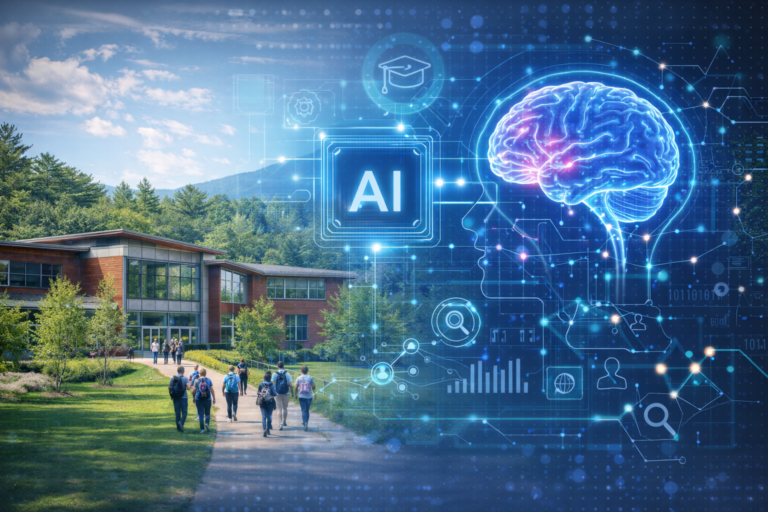
AI Isn’t the Bottleneck in Higher Ed. Data Silos are.

Turning Point Brands – Building a Scalable, Data-Driven Field Sales Operation

Christian Care Ministry – Experience Cloud Redesign/Build

Big Picture Learning – Intent-Driven Internship Discovery with Agentic AI

Antioch University – Predictive Engagement and Personalization Drive Enrollment Growth
Let’s Talk About
Your Salesforce Goals
We’re here to help you navigate your Salesforce journey with ease. Tell us about your needs and we’ll follow up to schedule a free consultation.
"*" indicates required fields